Skip to content
10 Things to Know Before Visiting the Gobi Desert

From singing sand dunes to sudden temperature swings, here is what every first-time traveler should pack and plan for before heading into Mongolia’s southern desert.
The Gobi is not what most people picture when they hear the word “desert.” There are dunes, but they cover only a small fraction of the land — most of the Gobi is gravel plain, rocky mountain and dry steppe stretching toward a horizon that never seems to end. It is also the coldest desert on Earth, a place of dinosaur fossils, nomadic herders and some of the darkest night skies in Asia. Before you go, here are ten things worth knowing.
1It's the coldest desert in the world
Unlike the Sahara or Arabian deserts, the Gobi is a cold desert. Summer days can reach 35–40°C, but winter temperatures regularly drop below -30°C, and even in July, nights can fall close to freezing. Whatever season you travel, pack layers.
2Sand dunes are only a small part of the landscape
Sand covers roughly 3 to 5 percent of the Gobi. The rest is a mix of gravel plains, rocky outcrops and semi-arid steppe. The famous Khongoryn Els “singing dunes” are a highlight precisely because they are the exception, not the rule — a 100-kilometre ribbon of sand rising up to 300 metres, named for the low hum the wind creates as it moves across the ridges.
3Expect long driving days between sights
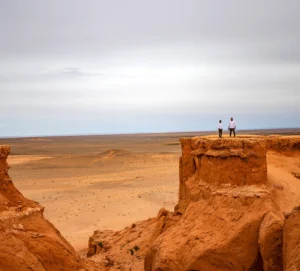
Major landmarks such as Yolyn Am, Khongoryn Els and the Flaming Cliffs of Bayanzag can be 80 to 300 kilometres apart, connected by a mix of paved road and open desert track. Most overland Gobi tours budget 3 to 8 hours of driving between stops, so the drive itself becomes part of the experience — a chance to watch the landscape shift from grassland to gravel to dune.
4Water and supplies are limited once you leave Ulaanbaatar
Beyond the provincial capital of Dalanzadgad, shops and pharmacies are scarce. Bring more bottled water than you think you’ll need, along with sunscreen, lip balm, hand sanitizer and any specific medication, since these are rarely available once you’re out in the desert.
Pack before you leave
Toiletries, chargers, snacks and any prescription items should all be bought in Ulaanbaatar. Ger camps are comfortable but basic, and there is no guarantee of a nearby shop.
5A good driver and vehicle matter more than you'd think
Gobi roads range from smooth pavement to deep sand and rutted gravel track. A well-maintained 4×4 — typically a Toyota Land Cruiser or similar — with an experienced local driver is essential, both for comfort and for genuine safety in remote stretches where help can be hours away.
6Nights get cold even in midsummer
The desert’s dry air and lack of cloud cover mean heat escapes quickly after sunset. Even travelers visiting in July and August are often surprised to need a warm layer, hat and gloves for evenings at ger camps, especially at higher elevations near Yolyn Am.
7The sun and dust are more intense than they look
At an average elevation of around 1,500 metres, with little shade and near-constant wind, sun exposure builds up quickly. A wide-brimmed hat, sunglasses and high-SPF sunscreen are essentials, and a scarf or buff is genuinely useful for the dust kicked up by vehicles and wind, particularly in spring.
8You'll likely stay in ger camps
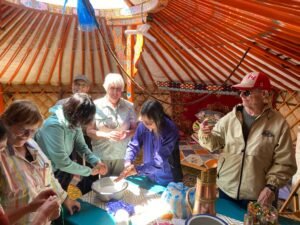
Most Gobi itineraries overnight in traditional ger (yurt) camps rather than hotels. Facilities are simple — often shared bathrooms and limited electricity — but the gers themselves are warm, welcoming, and a genuine part of the cultural experience rather than a compromise.
9You may be a guest in a nomadic family's home
Many tours include a visit to a local herding family. If you’re offered milk tea, airag (fermented mare’s milk) or dairy snacks, it’s polite to accept with both hands and take at least a sip, even if it’s not to your taste. These visits are a highlight for most travelers and a meaningful way to support local, pastoral livelihoods.
10The best window is roughly April through October
Spring can bring sudden sandstorms, so many travelers prefer late spring through early autumn, when daytime temperatures are milder and roads are most reliable. September brings golden light and thinner crowds at the major sites, while winter travel is possible but strictly for well-prepared, experienced travelers.
None of this is meant to discourage you — the Gobi rewards exactly the kind of preparation above with some of Mongolia’s most striking and least crowded scenery. Pack in layers, choose your driver carefully, and leave room in the schedule to simply sit and watch the light change over the dunes at sunset.
Plan Your Gobi Adventure
Let our team build a custom Mongolia itinerary around the places in this article.
Inquire Now